Resetting Expectations

Issue 28 — December 14, 2025
Welcome to Issue 28 of The Long Term Edge, your weekly guide to compounding over 7+ years.
This week reinforced a familiar pattern: fundamentals continue to improve beneath the surface, while markets remain highly sensitive to data, rates, and positioning. Earnings from key technology and infrastructure players, shifting liquidity conditions, and evolving regulatory signals are shaping the setup into year-end.
This Week in the Markets (Dec 8–12)
It was a contrasting week for U.S. equities, with the S&P 500 and Nasdaq Composite declining, while the Dow Jones Industrial Average gained, highlighting a split between tech-heavy leadership and more cyclical or defensive names.
The Federal Reserve delivered its third consecutive 25-basis-point rate cut at its final meeting of the year. Updated projections removed expectations for further cuts, but growth forecasts improved and the unemployment outlook remained largely unchanged.
Markets initially responded positively to the Fed’s economic projections, pushing the S&P 500 and Dow to new record closes mid-week for the first time since October and November, respectively.
That momentum faded as the AI trade came under pressure following earnings reactions from Oracle and Broadcom, where guidance, higher spending forecasts, and margin concerns disappointed investors.
By week’s end, the S&P 500 fell 0.6%, the Nasdaq declined 1.6%, and the Dow advanced 1.1%, reflecting rotation rather than broad risk-off behaviour.
Broadcom Earnings: Demand vs Financial Results.
Broadcom’s earnings confirmed what the market has been gradually pricing in: AI-related demand remains strong, but execution and capital discipline matter more than ever. Revenue growth was driven by networking, custom silicon, and AI-adjacent infrastructure, reinforcing Broadcom’s role as a critical supplier rather than a speculative beneficiary.
Margins and guidance signalled a measured approach to growth. Rather than chasing volume at any cost, Broadcom continues to prioritise high-return opportunities tied to long-term enterprise and hyperscale demand. This reinforces the idea that the AI cycle is maturing, with winners increasingly defined by efficiency and integration rather than raw exposure.
Broadcom’s post-earnings pullback reflects expectations resetting, not demand collapsing. The market focused on near-term margin pressure and a backlog figure that failed to impress, but the underlying signal remains intact: AI-driven networking and custom silicon demand continue to expand, just at a more measured pace.
For long-term investors, this type of reaction is often constructive. Broadcom operates deep in the infrastructure layer, where demand visibility is longer-dated and switching costs are high. Periods of earnings-driven volatility have historically created better entry points for patient capital, particularly when the business continues to prioritise cash flow and disciplined capital allocation.
Oracle Earnings: Quiet Strength in Enterprise AI
Oracle’s results highlighted steady progress in cloud infrastructure and enterprise workloads. While Oracle rarely dominates headlines, its positioning in databases, enterprise software, and sovereign cloud contracts continues to compound quietly.
The key takeaway was demand visibility. Oracle’s long-term contracts and backlog provide insulation against short-term volatility, while AI-driven database workloads add incremental upside. This is not a momentum story but a durability story, one that benefits as enterprises prioritise stability and cost control heading into 2026.
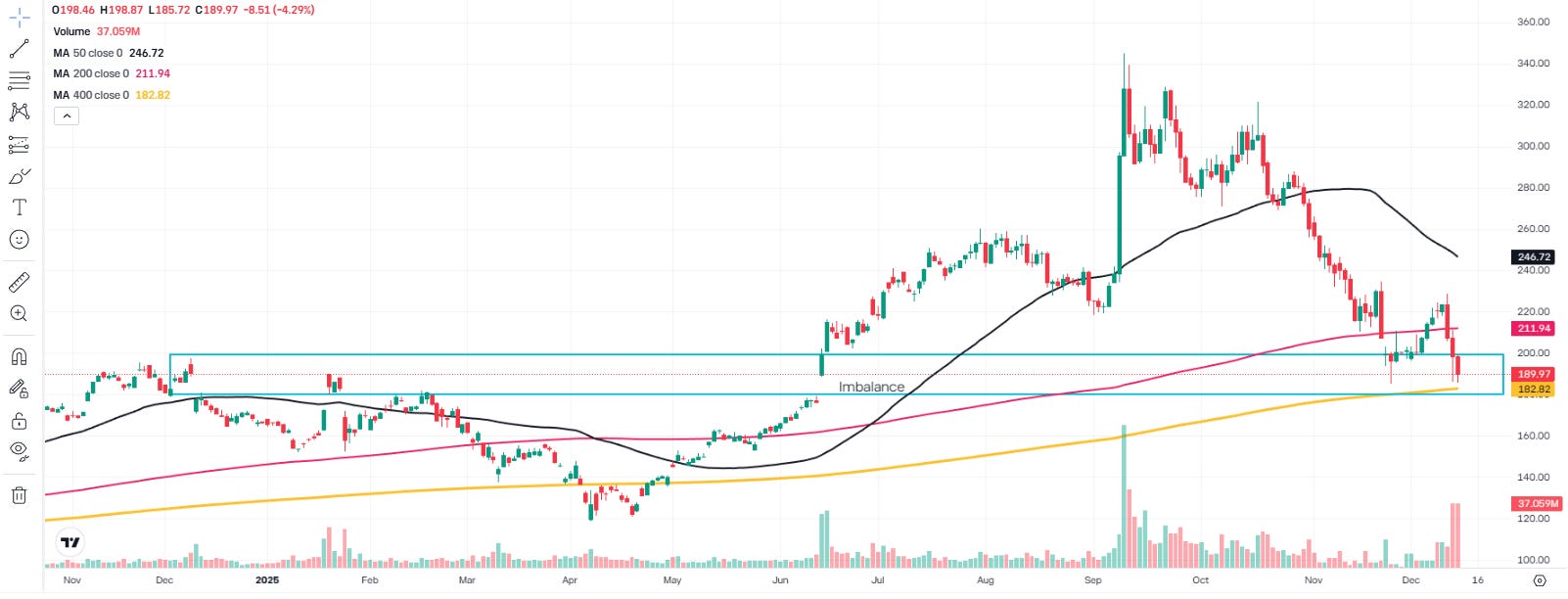
Oracle’s sell-off following earnings appears disconnected from the company’s strategic position. While guidance failed to excite in the short term, Oracle continues to benefit from long-duration cloud contracts, enterprise stickiness, and rising AI-related workloads tied to databases and infrastructure services.
The pullback reflects scepticism around growth acceleration rather than deterioration in fundamentals. For investors focused on durability rather than momentum, Oracle’s model; recurring revenue, high switching costs, and expanding cloud relevance — suggests the recent weakness may represent an opportunity rather than a structural warning.
I will be watching price action at its 400MA to open long leap option contracts.
Bitcoin: Consolidation, Not Capitulation
Bitcoin spent the week consolidating, but the underlying signal remains constructive. Volatility has cooled, not because interest is fading, but because ownership is gradually shifting towards longer-term holders and institutional participants.
This phase resembles a transition rather than a top. Liquidity conditions and macro expectations continue to influence price action, but structurally, Bitcoin is behaving more like a maturing asset class than a speculative trade. The absence of panic during pullbacks suggests growing confidence in its role as a long-duration hedge within portfolios.
AI Regulation: Noise vs. Reality
Regulatory headlines around AI continue to surface, but the practical impact remains limited. Most proposed frameworks focus on transparency and accountability rather than outright restriction. For large incumbents, regulation increasingly acts as a moat rather than a threat.
The companies with scale, compliance infrastructure, and capital are best positioned to absorb regulatory costs. Smaller, undercapitalised players may struggle, reinforcing consolidation rather than slowing adoption. Regulation is shaping the AI landscape; not stopping it.
SpaceX and the IPO Question
Speculation around SpaceX’s eventual IPO continues to build, driven by the scale of Starlink, launch cadence, and government contracts. While timing remains uncertain, the strategic implication is clear: space infrastructure is transitioning from frontier technology to essential infrastructure.
Public markets are increasingly focused on cash flow visibility, not vision alone. When SpaceX does come to market, valuation will hinge less on ambition and more on recurring revenue, margins, and capital efficiency, a shift that mirrors broader market evolution.
Week Ahead (December 15–19)
Monday:
The final full trading week before the holidays opens with elevated volatility risk in Bloom Energy (BE) and Hut 8 (HUT). Semiconductor-focused investor meetings featuring ACMR, AEIS, and FORM, alongside Fed commentary, will shape early sentiment around capex discipline and demand visibility into 2026.
Tuesday:
Macro data moves into focus with delayed jobs and retail sales reports. Earnings from Lennar (LEN) offer a read on housing demand, while healthcare and software updates help frame year-end spending trends.
Wednesday:
Midweek earnings from Micron (MU) and Jabil (JBL) provide insight into memory cycles and manufacturing demand, while General Mills (GIS) acts as a signal for staples pricing power. Fed speakers remain a background driver.
Thursday:
This is the most consequential day of the week. CPI data and European central bank messaging will directly influence rate expectations. Heavyweight earnings from Accenture (ACN), Nike (NKE), FedEx (FDX), CarMax (KMX), and Darden (DRI) offer a broad read on enterprise spending, logistics activity, and consumer resilience heading into 2026.
Friday:
The week ends with triple witching, adding mechanical volatility as options and futures expire simultaneously. Earnings from Carnival (CCL) and Conagra Brands (CAG) round out the week.
This is a confirmation week, where data and large-cap earnings matter more than narratives, with year-end liquidity amplifying moves.
Closing Thoughts
Markets are entering year-end with clarity rather than conviction. Inflation, rates, and earnings continue to matter more than narratives, while liquidity conditions amplify both upside and downside moves.
The opportunity for long-term investors remains unchanged: focus on durable businesses, structural demand, and balance sheet strength and ignore the noise that dominates short-term price action.
Clarity compounds. Stay long-term.
Disclaimer: This newsletter is for informational purposes only and is not financial advice. Always do your own research or consult a licensed advisor.