Meta’s Pivot

Welcome to Issue 57 of The Long Term Edge, your weekly guide to compounding over 7 or more years. The first half of 2026 closed this week with a jobs report that changed the rate hike conversation; a Supreme Court ruling that preserved Federal Reserve independence; Meta announcing it is launching a cloud business that made its Neocloud competitors pull back; and a Nike earnings release that looked spectacular on the headline and considerably less so underneath it. The second half opens with June CPI on Wednesday and FOMC minutes also this week. The market is repricing what it thought it knew about rates, AI infrastructure, and consumer demand, all at once.
Market Overview
A Holiday Week That Packed in a Full Month of News
Monday opened with a strong relief rally. The Nasdaq rose 2%, the S&P 500 gained 1.2%, and the Dow put on 0.6% to close above 52,000 for the first time in its history. Alphabet joined the Dow Jones Industrial Average that morning, replacing Verizon, and rose more than 4% on its first day as a component. A Supreme Court ruling held that Federal Reserve governor Lisa Cook would remain in her position, rejecting the Trump administration’s attempts to remove her, with the court carving out an explicit exception for central bank independence. On the Iran front, easing tensions helped lift markets after the US and Iran agreed to stop tit-for-tat attacks, with Trump announcing the two nations would meet in Doha on Tuesday for renewed talks. Tesla surged 8%, SpaceX gained 2.3%, and semiconductor names bounced sharply from the prior week’s selloff.
Tuesday brought the biggest structural AI story of the week. Bloomberg reported that Meta is planning to launch a cloud business, dubbed Meta Compute, to sell excess AI compute capacity to third parties. Meta shares surged on the news. CoreWeave and Nebius each fell approximately 12%, as the announcement signalled that one of their largest potential customers would now become a direct competitor. The same day, Rocket Lab announced it would acquire Iridium in an $8 billion deal, sending Iridium up 25%, Rocket Lab up 16%, and space sector names broadly higher.
Wednesday introduced fresh AI jitters. Reports emerged that OpenAI had begun discussions about selling a 5% equity stake to the US government via a proposed Public Wealth Fund. The news added to a broader reconsideration of AI valuations and capital allocation dynamics. Meta fell 5% and Tesla fell 7.5% despite reporting strong delivery numbers. Micron sank 7%, Applied Materials fell 7.4%, and AMD dropped 4.3%. The S&P 500 dropped 0.4% and the Nasdaq 100 slipped more than 2% as chipmakers sold off for a second consecutive session.
Thursday delivered the week’s defining number. June nonfarm payrolls came in at 57,000, well below the 115,000 consensus and revised down from the prior two months by a combined 74,000. The soft print immediately removed September from the rate hike timeline. The Dow climbed 595 points to a new record at 52,844 as Apple gained 4.8%, Walmart rose 3%, and McDonald’s gained 4%. The S&P 500 was roughly flat and the Nasdaq 100 fell 0.8% as chip names continued to sell off. For the week: S&P 500 up 1.8%, Nasdaq up 2.1%, Dow up 2%. Markets were closed Friday for Independence Day.
Week Ahead
July 7 to 11: CPI, FOMC Minutes, and Bank Earnings
Monday July 7
Markets reopen after the Independence Day holiday. SpaceX joins the Nasdaq 100 on this date, following Nasdaq’s confirmation of its fast-tracked addition. The addition will trigger forced buying from index-tracking funds, which could provide a near-term technical tailwind for SPCX shares that has nothing to do with the underlying business fundamentals. A light economic calendar makes positioning for the week’s heavier events the primary activity of the session.
Tuesday July 8
JOLTS job openings for May land, the last major labour market read before the week’s main events. Consumer credit data for May also releases. PepsiCo reports before the open, giving one of the first major consumer staples reads of the second half earnings season and a useful read on whether pricing power is holding against the inflation backdrop.
Wednesday July 9
June CPI lands at 8:30 a.m. ET. This is the first inflation print that should begin reflecting the easing in energy prices following the Iran ceasefire framework. May’s headline CPI was 4.2%, driven overwhelmingly by the energy shock. With Brent crude now trading in the low $70s after falling from above $100, the energy component should pull headline CPI meaningfully lower. Core CPI is the number that matters most for the Fed’s rate decision calculus. The FOMC minutes from the June meeting, Kevin Warsh’s first as chair, also drop Wednesday. The minutes will give a behind-the-scenes read on the committee’s internal deliberations that the shortened post-meeting statement deliberately obscured.
Thursday July 10
Major bank earnings begin. JPMorgan Chase, Wells Fargo, and Citigroup all report before the open. Bank earnings are one of the most reliable leading indicators for credit conditions, loan demand, and the health of the consumer and corporate balance sheet. In the current environment, with rate hike odds having shifted dramatically following Thursday’s jobs report, bank commentary on net interest margin outlook and loan growth will be particularly closely watched. Delta Air Lines also reports, offering an early read on travel demand heading into peak summer season.
Friday July 11
June PPI drops alongside the University of Michigan’s preliminary July Consumer Sentiment reading. Producer prices will give a forward-looking read on whether goods inflation has genuinely peaked or whether the supply chain pressures flagged by Apple’s price hike announcement are still working their way through. Goldman Sachs and BlackRock report, completing the first week of the second half earnings season.
Jobs And Interest Rates
Three consecutive months of stronger-than-expected jobs data had built a near-ironclad case for a Fed rate hike before year end. April came in at 148,000 revised. May came in at 129,000 revised. Both were well above consensus at the time of their initial release. Heading into Thursday, the market was pricing a meaningful probability of a September hike, nine of eighteen FOMC members had already pencilled one in on the dot plot, and Kevin Warsh’s own inaugural press conference had been read as hawkish.
Then June arrived at 57,000.
The Bureau of Labor Statistics reported that the US economy added just 57,000 jobs in June, below the revised 129,000 in May and less than half the 115,000 consensus. It was the weakest single month of job creation since early 2025. Prior months were revised down simultaneously: April cut by 31,000 from 179,000 to 148,000, and May cut by 43,000 from 172,000 to 129,000, removing 74,000 positions previously reported. The household survey was even weaker, with 507,000 fewer people reporting themselves at work, a figure that sent the labour force participation rate down 0.3 percentage points to 61.5%, its lowest level since March 2021.
The breakdown offers some structural context. Professional and business services added 36,000, social assistance added 25,000, and healthcare rose by 22,000. These are the stable, secular-growth categories that have driven job creation consistently through the past two years. What collapsed was leisure and hospitality, down 61,000, a reversal the BLS attributed to weaker than usual seasonal hiring, a pattern that analysts have since connected to the FIFA World Cup effect. Seasonal adjustment models expect certain hiring patterns from the hospitality sector in June each year. In 2026, those patterns were distorted by World Cup-related hiring in May and early June, with the adjustment pulling forward jobs that did not materialise in the usual way when measured against the seasonal baseline.
Average hourly earnings rose 0.3% for the month and 3.5% year-on-year, both in line with forecasts. Wage growth is holding steady but not accelerating, which is precisely the combination the Fed needs to avoid the services inflation spiral that would make a rate hike unavoidable regardless of the headline jobs number.
The market’s read was immediate and decisive. Following the jobs print, traders took a potential September hike off the table. Futures still point to a possible October increase, but that probability has fallen meaningfully. Jefferies senior economist Thomas Simons put it plainly: “For the Fed, this number is fine. The pace of job growth is plenty strong enough to maintain a steady unemployment rate and average hourly earnings are solid, but not accelerating. There is no imperative on their part to do anything with rates immediately, and the softening in the pace of job growth suggests that rate hikes are very unlikely to be necessary this year.”
Warsh himself has repeatedly said he will not provide forward guidance and is “not committed to any type of policy path.” That posture, combined with a June jobs report that removes urgency without signalling deterioration, gives the Fed exactly the space it needs to stay on hold through the summer and let the inflation picture clarify. Wednesday’s CPI and the FOMC minutes will tell us whether the committee is inclined to use that space or push through with the hike the dot plot suggested.
Meta Compute
Meta’s announcement this week that it is launching a cloud business to sell excess AI compute capacity was, on its surface, a story about Meta’s capex strategy. Underneath the surface, it is one of the most significant structural shifts in the AI infrastructure market this year, and it has direct implications for every investor with exposure to neocloud names like CoreWeave, Nebius, or any company whose business model depends on hyperscalers being consumers of compute rather than sellers of it.
The background: Meta has committed $145 billion in capital expenditure for 2026, the largest single-year infrastructure investment in the company’s history. That spending has built a network of data centres and GPU clusters that is, by some estimates, larger than what the company currently needs for its own AI model training and inference workloads. CEO Mark Zuckerberg first signalled the possibility of a cloud move at the Q3 2025 earnings call. Bloomberg’s report this week confirmed that the initiative, named Meta Compute and led by infrastructure head Santosh Janardhan alongside Meta Superintelligence Labs leader Daniel Gross and president Dina Powell McCormick, is now operational rather than theoretical.
The competitive implications are direct and serious. CoreWeave and Nebius each fell approximately 12% on the news. The logic is straightforward: Meta entering the market as a seller of raw compute capacity creates supply that competes directly with the inventory CoreWeave and other neocloud providers have built at enormous cost. CoreWeave’s entire business model rests on the premise that there is a gap between what hyperscalers provide and what AI-focused customers need, a gap filled by purpose-built GPU cloud infrastructure from specialised providers. If Meta is now filling part of that gap itself, using capacity it has already paid for, the addressable market for CoreWeave and its peers contracts.
There is a more constructive read on this development, and it is worth taking seriously. Meta’s decision to sell excess compute rather than simply absorb the cost of unused capacity is evidence that the hyperscaler build-out has genuinely overshot near-term demand in at least one corner of the market. That is not a new concern. CoreWeave’s own guidance miss in May and OpenAI’s revenue shortfalls earlier in the year both pointed in the same direction. What Meta’s announcement adds is the clearest confirmation yet that even the most aggressive capex spenders have built more than they currently need, and are now trying to recoup those costs through commercial channels rather than waiting for internal demand to catch up.
For long-term investors, the Meta Compute announcement asks a question this newsletter has framed repeatedly since Issue 48: is the $690 billion committed to AI infrastructure in 2026 creating genuine, durable, proportionate demand, or is it creating a supply glut in certain categories that will eventually require a painful realignment? The answer, based on this week’s evidence, is more nuanced than either the bulls or bears are acknowledging. Demand is real. Supply has overshot demand in the near term. The mechanism by which supply excess is resolved, through commercial monetisation like Meta Compute, through write-downs, or through demand eventually catching up, will determine which names in the AI infrastructure ecosystem compound through this period and which ones do not.
Nike, and the Tariff Refund.
Nike reported fiscal Q4 2026 earnings on Tuesday, and the headline numbers looked extraordinary. Diluted EPS of 72 cents crushed the 13-cent consensus. Gross margin expanded 890 basis points to 49.2%. Net income surged 407% year-on-year to $1.1 billion.
Strip out the one-time item and the picture changes entirely.
The 72 cents per share included a 52-cent benefit from the expected recovery of IEEPA tariff refunds, a $986 million one-time accounting item related to the anticipated repayment of import duties collected under International Emergency Economic Powers Act provisions. Remove that item and Nike’s underlying EPS was 20 cents. The 890 basis point gross margin expansion was almost entirely attributable to the same tariff refund, which contributed roughly 900 basis points on its own. Without it, gross margin was essentially flat.
The operational numbers underneath the tariff benefit told a consistent story of a company still in the middle of a difficult turnaround. Q4 revenue came in at $10.97 billion, down 1% reported and down 4% on a currency-neutral basis. Greater China sales fell 12% to $1.30 billion. Nike Direct revenues fell 7%, with digital sales down 12% and Nike-owned stores down 7%. Converse revenue dropped 32% to $244 million, down across all territories. Full-year revenue of $46.4 billion was flat on a reported basis and down 2% on a currency-neutral basis.
CEO Elliott Hill was direct about where things stand. “We continue to face top-line headwinds. Overall, the results aren’t there yet.” Outgoing CFO Matthew Friend offered guidance expecting revenue to decline low to mid-single digits in the near term, with Q2 of fiscal 2027 sequentially weaker due to prior year anomalies. Earnings were expected to be “flattish” through the next three quarters, excluding any further tariff recovery benefit.
The one bright spot in the quarter was performance categories. Running, Football, and Basketball all grew in the mid-single digits, suggesting that the brand’s core athletic credibility remains intact even as the lifestyle and streetwear segments, particularly Sportswear and Jordan, continue to face sell-through challenges in both the US and China.
This newsletter returns to a principle that runs through every earnings analysis it publishes: headline beats that rest on one-time items are not the same as operational momentum. The distinction matters enormously for long-term investors trying to assess whether a turnaround is real or whether it is being masked by accounting items that will not recur. In Nike’s case, the tariff refund boosted a single quarter’s EPS by 2.6 times the underlying result. Investors who read the headline number and concluded that Nike’s recovery is accelerating drew a very different conclusion than those who read through to the currency-neutral revenue decline and the 12% fall in China sales.
The turnaround case for Nike remains credible over a longer horizon. The performance category momentum is real. The brand retains extraordinary recognition globally. The new management team is making structural changes to the marketplace and supply chain that have a multi-year payoff timeline. But the turnaround is not yet showing up in the operational numbers in a way that would justify confidence that the most difficult phase of the reset is behind them. That is the honest read on a quarter the headlines described as a beat.
OpenAI’s Public Wealth Fund Proposal
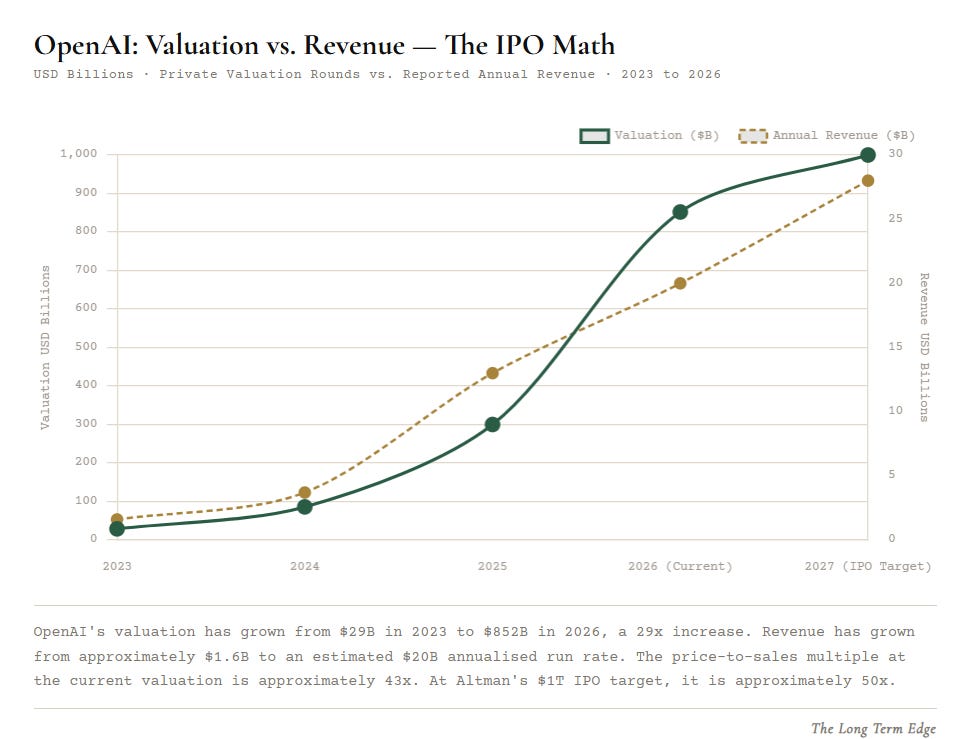
On July 2, the Financial Times reported that OpenAI is in talks to voluntarily hand the US government up to 5% of its equity, worth approximately $42.6 billion at the company’s current valuation of roughly $852 billion, via a new structure called the Public Wealth Fund. The proposal, championed by CEO Sam Altman, would place that equity block into a sovereign-wealth-style fund designed to distribute AI-generated returns directly to US citizens, rather than routing AI profits through the tax system in the conventional way.
This arrived in the same week that Altman reportedly rejected a lower-valuation IPO path in favour of waiting until 2027 for a listing at or above $1 trillion, and in the same week that SoftBank closed a second $10 billion tranche of its planned $30 billion follow-on investment in OpenAI. The timing is not coincidental. It reflects a company navigating an increasingly complex set of pressures simultaneously: regulatory scrutiny from the DOJ and FTC, antitrust questions about its market dominance in consumer AI, political scrutiny about its relationship with the Trump administration, and the capital markets reality that its most recent private valuation of $730 to $850 billion is well below the $1 trillion target Altman insists on for any public listing.
The mechanics of the proposed fund raise questions the reporting leaves largely unresolved. Whether the 5% stake vests immediately or is contingent on milestones such as an IPO or revenue thresholds. Who controls the voting rights, and whether a passive Treasury holding would function differently from an active government board seat. How the fund would distribute returns, whether through per-capita citizen dividends, retirement account contributions, or infrastructure spending. And whether a government equity stake in the most commercially dominant AI lab in the world creates novel antitrust complications that have no precedent in modern regulatory history.
For investors watching the broader AI capital markets story, the Public Wealth Fund proposal has two readings in tension. The optimistic read is that Altman is making a sophisticated regulatory arbitrage move, pre-emptively creating a political constituency among US citizens who would benefit from OpenAI’s commercial success, thereby reducing the probability of aggressive antitrust action and smoothing the path to a $1 trillion IPO in 2027. The more skeptical read is that OpenAI is facing enough regulatory and competitive pressure that it has determined proactive political positioning is less costly than the alternative.
What the proposal unambiguously signals is that Altman does not believe a straightforward commercial IPO at the valuation he is targeting is achievable in the current environment without some form of structural political accommodation. That is a meaningful statement about where AI valuations and public market appetite actually stand. Anthropic, which has filed confidentially and is widely expected to pursue a listing in late 2026, will be watching closely to understand what precedent the OpenAI-government relationship sets for its own regulatory positioning. And any long-term investor considering AI exposure through the IPO wave that was supposed to define 2026 now has a more complicated picture to navigate than the straightforward growth story the pre-IPO hype suggested.
Closing Thoughts
The first half of 2026 closed with an S&P 500 that had navigated an Iran conflict, a new Fed chair, accelerating inflation, a record IPO, and one of the most extraordinary earnings seasons in semiconductor history. It delivered a positive total return despite all of it, which is itself a remarkable statement about the resilience of corporate earnings as an anchor in a volatile macro environment.
The second half opens with the same questions the first half could not fully resolve. Is the Iran ceasefire durable or is the Strait of Hormuz the next point of escalation? Will Warsh hold rates or hike, and does a 57,000 job print change the calculus that nine of his committee members had already committed to? Is the AI infrastructure build-out generating returns proportionate to the spending, or is Meta Compute the first visible crack in the assumption that every dollar of hyperscaler capex translates into lasting competitive advantage?
Wednesday’s CPI will be the first data point that begins to answer the inflation question for the second half. The FOMC minutes will tell us whether the committee is leaning toward using the space the soft jobs print has given them. And Nike’s quarter, read carefully rather than at the headline, is a reminder that the discipline of looking through one-time items to the operational reality underneath them is the work this newsletter exists to do.
The edge is built one week at a time. The second half has just begun.
Clarity compounds. Stay long-term.
Disclaimer: This newsletter is for informational purposes only and is not financial advice. Always do your own research or consult a licensed advisor.